

Widening Our Vision - September 6, 2015
Our Church Council begins each meeting by reading our church's mission statement. It is printed in your bulletin today and I invite you to join me now in saying it together: "Moscow First United Methodist Church is a welcoming family of believers committed to living the gospel of Jesus Christ in our community and our world through worship, music, Christian Education, service, and prayer."
At their best, mission statements guide the work of an organization, be that a church, a university, or a hospital. They are most helpful when they are concise, focused, and used frequently enough that people know them. Over the last ten years, our Council has revised our mission statement several times, in each case tightening it up. We used to have one that was three paragraphs long. Now it is just one sentence. It could be refined even further to one phrase: "living the gospel of Jesus Christ."
The nation of Israel never wrote a mission statement. Had such things been in vogue four thousand years ago they might have chosen the verse known as The Shema, from the Hebrew word for to hear. Faithful Jews still recite it twice a day, on waking and just before going to sleep. "Hear, O Israel, the Lord our God, the Lord is one."
Some might argue that The Shema is more a statement of belief than a mission statement. Perhaps Micah 6:8 puts it better: "What does the Lord require of you but to do justice, and to love kindness, and to walk humbly with your God."
Jesus mission statement is perhaps easier to identify: "The time is fulfilled, and the kingdom of God has come near; repent, and believe in the good news." Or perhaps it was, "The Spirit of the Lord has anointed me to bring good news to the poor."
A mission statement clarifies purpose. It helps one to know where to put time and energy. That can also help a person or group to know what not to do, what activities can be released. For many years this church has enjoyed holding a Thanksgiving Dinner for members whose families live too far away to gather together on that special day. Numbers have dropped in recent years and we've had trouble finding someone to organize the dinner. The council has decided that may be a sign to let go of the dinner. Our mission to live the gospel of Jesus Christ can happen in other ways. In the same way the United Methodist Women have disbanded. Their last remaining activity, a rummage sale, will no longer take place. The UMW did wonderful acts of mission for many years. The rummage sale was itself an outreach not only to the folks who bought items for a low price but also through the ministries supported by the proceeds. Our mission to live the gospel of Jesus Christ will now happen in other ways.
Jesus' mission is central to our story today from the Gospel of Mark. This is a difficult story. Jesus has traveled to the region of Tyre, an area not populated by Jews. It seems he may be trying to take a vacation. He hopes not to be noticed. Likely he is worn out from teaching and healing. Everyone needs a break.
Even in Tyre, however, Jesus can't escape the people who need his ministry. A Syrophoenician woman seeks him out. Her daughter is ill. Parents will do anything to get help for their kids and this woman finds Jesus. She is not Jewish.
Syrophoenicians were people of mixed background, part Phoenician and part Syrian. A hundred years ago we might have called this woman a half breed. Today we'd say mixed race. Jews were suspicious of blending things together. They didn't wear blended fabrics or plant two kinds of seed in the same field.
This woman does not fit Jesus' mission statement. Matthew's version of this story is clearer than Mark's. In Matthew Jesus tells the woman, "I was sent only to the lost sheep of the house of Israel." In Mark Jesus says, "It is not fair to take the children's food and throw it to the dogs." Jesus can't help her. She doesn't meet the criteria in his mission statement.
Jesus calls the woman a dog, a racial slur. His words do not match with our perception of gentle Jesus, meek and mild. Jesus is not nice here. Sure, maybe he was tired and snapped at the woman who hounded him to heal her child, but shouldn't Jesus, the Word of God made flesh among us, be above such things? This is truly an uncomfortable story.
The woman's vision, born of her need, is broader than Jesus' strict adherence to his mission statement. She doesn't challenge him for his use of the politically incorrect racial slur. Her faith calls him to a larger vision of God's mission. She says, "Sir, even the dogs under the table eat the children's crumbs." She doesn't cite Isaiah but maybe Jesus was spurred to remember how Isaiah had said, "Nations shall come to your light."
This unnamed woman radically reorientes Jesus' mission. He tells her, "For saying that you may go – the demon has left your daughter." Without touching the child as Jesus normally did in healing, without even seeing her, Jesus heals the little girl. His power was expanded by the woman's faith.
Jesus then continues on his vacation and makes a broad sweep around through the Decapolis, a federation of ten Greek cities. He is still in Gentile territory. Someone brings him a man who is deaf, apparently from birth, since he has difficulty speaking. Jesus takes the man aside, puts his fingers in his ears, spits and touches his tongue, and prays, "Be opened." The man can hear and he speaks plainly. Still trying to be unnoticed, Jesus orders them to tell no one, "but the more he ordered them the more zealously they proclaimed it." Jesus' mission expands however hard he tries to limit it.
There are so many things which can limit our vision and restrict our ministry. Like Jesus, we get tired. We get worn out. We get exhausted. Most churches, like many other organizations, are plagued by the 80/20 syndrome, in which eighty percent of the work is done by twenty percent of the people. And so we are in constant need of nursery and activity time volunteers, Sunday School teachers, people to help with Family Promise, and nearly every other program in our church. If we had even ten % more people to help it would make a big difference. Cutting down on our activities, from the Thanksgiving Dinner to the rummage sale, reduces the number of things for which we need volunteers. Asking, "Does this program fit our mission statement?" is an important question.
We human beings are plagued by our isms: racism, sexism, ageism, and the like. In a community that was 75% Hispanic, I served a predominantly white congregation. One woman told me, "We don't need to start a Hispanic ministry. Soon technology will develop so apples can be picked mechanically and they'll all go back to Mexico." Our mission was limited. Now most of the Anglo congregation has either died or has left for another church and a vibrant Hispanic congregation is growing in its place.
"We've always done it this way," and its twin, "We've never done it that way," are said so often that they have become clichés. The truth is such an attitude does limit our vision so that we don't try new things or reach out in new ways. New things are scary and change is difficult, no question about it, and the limited vision that comes with those old clichés holds us back from truly living the gospel of Jesus Christ.
"Moscow First United Methodist Church is a welcoming family of believers committed to living the gospel of Jesus Christ in our community and the world through worship, music, Christian Education, service, and prayer."
It has been a good thing to sharpen our vision by tightening up our mission statement. I'm sad to let go of cherished programs like the rummage sale and the Thanksgiving Dinner, and I think doing so is necessary in order to free up our energy for programs which help us to live out the gospel of Jesus Christ in this day and age.
And I wonder, in what ways do we need to widen our vision? Who are the people left to eat the crumbs under the table who we must now invite to join us at the table? Who are the people who will widen our vision when we learn to see them as the beloved children of God?
Current Church News
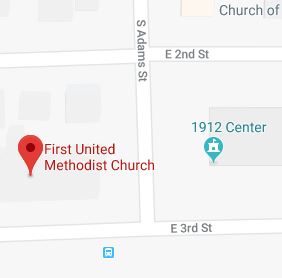
Get Directions
Sunday morning parking at the church is available in the high school parking lot on Third Street across from the church and in the city lots west of the church. These lots are available only on Sunday mornings. A small lot for handicapped parking is available just off of Adams Street on the north side of the church, with an accessible entrance directly into the sanctuary. A lift operates between the Fellowship Hall (3rd Street level) and the Sanctuary. William Sound System Receivers and Headsets are available to assist with hearing problems.
322 East Third Street
Moscow, ID 83843
Church Mission
The First United Methodist Church of Moscow, Idaho takes as our mission to be the body of Jesus Christ, ministering to a community which draws strength from its diversity. Our mission centers on the worship of God, expressed through varied forms of prayer, preaching, music, and ritual. See more...