

The Salt Within Us - September 27, 2015
Does anyone here know what is the largest organ in the human body? It is not the liver, or the heart, or the lungs. It is skin. Skin covers us from head to toe. Obviously some of us have more of it than others, and for all of us the amount of skin surpasses the size of any other organ.
Skin is amazing. In many ways it is the most vulnerable part of our bodies: misjudge while slicing carrots and you cut your finger; push the lawn mower too close to the rose bush and you scratch your arm; trip over a crack in the sidewalk and you skin your knee. Mosquitoes, wasps, and spiders all bite us on our skin. Most of the time those are minor injuries and they still hurt. Usually our skin heals itself in a matter of days. It is amazingly resilient – stretching as we grow, retracting back after the baby is born or a person loses a lot of weight. Ok, sure, there may be some stretch marks, but not huge flaps of left over skin.
Skin keeps us in, holding blood vessels and tissues. It defines us, be that by ethnicity or family. It is the first defense against disease. At the same time skin is porous. Pharmacists have learned how to give medication through the skin with patches that deliver long term dosages. Skin is truly amazing.
Today's Scripture reading from Mark describes the church as the skin of the community of faith. Didn't catch that reference? Let me explain.
The first part of our reading begins as the disciple John complains to Jesus, "Teacher, we saw someone casting out demons in your name and we tried to stop him, because he was not following us." Under John's words I can hear him trying to be skin for Jesus – the first line of defense against invasion from the outside. "He's not one of us!" John protests. John is trying to establish the boundaries for discipleship.
His protest makes sense. After all, Jesus had just told them, for the second time, that he would be betrayed and killed. Discipleship is not for sissies. It is serious business. Discipleship in the end will mean taking up a cross.
To heal in Jesus' name meant to claim the power and authority of Jesus. Just as I would not give a stranger, or honestly, even a friend, my bank account number or the password to any of my various email accounts, so the power of Jesus should not be accessible to just anyone. "He was not following us," John reasoned.
Jesus, however, responds, "Do not stop him; for no one who does a deed of power in my name will be able soon after to speak evil of us. Whoever is not against us is for us." Jesus recognizes that the skin of the church is porous. It breathes in and out the Holy Spirit. It welcomes people into its fellowship even as others choose to leave that fellowship. There are no locked doors for the community of faith.
The porous skin of the church has long been a matter of confusion for us. On the one hand, we Methodists pride ourselves in practicing open communion. I say, "You do not have to be a member. You must only be hungry and thirsty for God in your life." The very earliest Methodists, on the other hand, did not practice open communion. While most gatherings were open to everyone, communion services were closed, because it was there that people bared their souls to each other. In both good and unfortunate ways we have changed that practice. I am glad we are porous when it comes to communion, though sad that we have lost the willingness to truly ask each other, "How is it with your soul?"
Fifty years ago the nature of society allowed for harder edges to the church. At that time people moved to town, joined a church, and then got involved. People today are different. They are more likely to participate first and later, maybe, become formal members, of a service club, a social group, or a church. The boundaries are porous. And so we welcome people as they sing in the choir, help out with Family Promise, or show up for a work party long before they become members of First United Methodist Church. Our skin is porous.
At the same time, it is common for folks to participate or even join for a while and after a few years decide they fit better at another church. Membership is no longer a life time commitment for most people. I grieve and agonize when people move on from us – and our skin is porous.
Our Gospel reading also recognizes how the skin of the church defines it, just like the skin on our bodies hold us in and protects our other tissues. In another difficult passage, Jesus offers hard words. "If any of you put a stumbling block before one of these little ones who believe in me, it would be better for you if a great millstone were hung around your neck and you were thrown into the sea." Ouch. He goes on to say similar things about other body parts that might lead one to sin – hand, foot, and eye. Better to cut it off than be thrown into hell.
These are harsh words. The Greek translated as stumbling block is scandalizo, to scandalize. It refers to words or actions that divert one from faith, that might trip someone up, like sticking out your foot in front of someone carrying a heavy package so they fall down. This is no minor offense. Jesus is talking about actions that truly harm another person's faith.
The skin on my hands protects me from disease, forming a barrier between a germ or bad microbe and the rest of my body. It's why hand washing is the best protection against disease. In the same way the church does need skin to define it and protect its members from sin.
Even as we welcome all people into our church, we also need to clearly define who we are as followers of Jesus. We are not simply a group of nice people who support good programs in our community. We are people who profess faith in Jesus Christ as our Lord and Savior, who have committed to follow Jesus even when that leads to suffering.
We are Methodist Christians who, with John Wesley, believe there is no holiness but social holiness. We do our best to live out the Gospel of Jesus Christ in our relationships within our families, our community, and the world. If following Jesus turns someone off, then so be it, painful as it is to see them leave.
Thirty years ago at a meeting of Sunday School teachers, one teacher admitted that she did not believe in God. She was willing to teach to support her kids who liked to come with their friends. Like most churches we always needed Sunday School teachers. I appreciated her honesty and her willingness to help. She certainly was welcome to come to worship, to attend a class. And a teacher needed to be a believer and a role model for the children in the class. We thanked that woman for her service and found other teachers. The skin of the church defined who we were.
This chapter in Mark ends with a familiar image used in a bit different way than we may be used to: "For everyone will be salted with fire. Salt is good; but if salt has lost its saltiness, how can you season with it? Have salt in yourselves, and be at peace with one another." Maybe you remember the more familiar verse from Matthew: "You are the salt of the earth."
In Jesus' day, salt was a precious commodity. It was used as a preservative for foods. Because of its value, Roman soldiers were paid in salt rations, the origin of our word salary.
As the church, both clearly defined and yet porous, we have within us the quality of preservation. We proclaim the message of salvation, or wholeness and health. Indeed, we are the instruments of God's salvation in the world.
Work out at the gym or sit in the sun for a while and your skin may get a bit salty because you have perspired. When we do the hard work of faith –loving our enemies, praying for those who persecute us, and following Jesus even to the cross – the salt within us will be evident. Our skin will be salty.
Skin: the largest organ in the body of Christ, both porous and yet defined. Thanks be to God for the skin of the church.
Current Church News
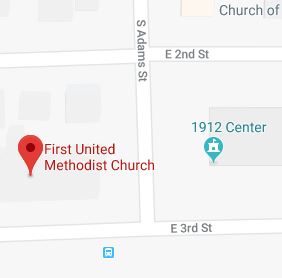
Get Directions
Sunday morning parking at the church is available in the high school parking lot on Third Street across from the church and in the city lots west of the church. These lots are available only on Sunday mornings. A small lot for handicapped parking is available just off of Adams Street on the north side of the church, with an accessible entrance directly into the sanctuary. A lift operates between the Fellowship Hall (3rd Street level) and the Sanctuary. William Sound System Receivers and Headsets are available to assist with hearing problems.
322 East Third Street
Moscow, ID 83843
Church Mission
The First United Methodist Church of Moscow, Idaho takes as our mission to be the body of Jesus Christ, ministering to a community which draws strength from its diversity. Our mission centers on the worship of God, expressed through varied forms of prayer, preaching, music, and ritual. See more...