

The Trouble With Wealth - October 11, 2015
A very rich woman died and appeared before the Pearly Gates. Gabriel met her. "What have you done that I should admit you to heaven?" he asked.
"I think I've been a pretty good person all my life," she said.
"That's nice," said Gabriel. But what have you done? You know, charity work and things like that?"
"Oh," said the woman. She thought for a long moment. "Well, one time as I was walking down Wall Street to my office, a panhandler asked me for money to buy coffee, so I gave him $5."
"That's nice," said Gabriel. "Anything else?"
She thought some more. "Oh, I remember. Another time as my chauffeur was driving me to a party there was a terrible snow storm. We got stuck. I looked out the window and there was a woman with a sign saying she needed food for her kids. I sent my aide out to give her a $10 bill."
"That's nice," said Gabriel. "Anything else?"
"Someone in the office was collecting money for the cancer fund and I wrote a check for $100."
"That's nice. Anything else?"
"No, I think that's about it."
Gabriel didn't know what to do with this woman, so he turned to St. Peter to ask for advice. Peter told him, "Write her a check for $115 and send her to hell."
In our reading today from the Gospel of Mark, a man runs up to Jesus and asks, "Good Teacher, what must I do to inherit eternal life?" Jesus tells him to observe the commandments and the man replies that he has done so since his youth.
Unlike some of the others who questioned Jesus in order to trick him, this man seems sincere in his question. He is a good person. It is only further into his story that we learn his problem. After telling him to observe the commandments, we read this poignant line, "Jesus, looking at him, loved him and said, 'you lack one thing; go, sell what you own, and give the money to the poor, and you will have treasure in heaven; then come, follow me.'"
"Jesus, looking at him, loved him." In his love for this man, Jesus identified the barrier which kept the man from his longing for eternal life: wealth. The man left grieving because he had many possessions. His wealth prevented him from obtaining eternal life, not because there is anything inherently wrong or bad about wealth, but because, as so often happens, the man was possessed by his possessions.
Jesus then said to his disciples, "How hard it will be for those who have wealth to enter the kingdom of God."
One of the troubles with riches is our tendency to trust them rather than God. Just before our story today, Jesus had said, "Whoever does not receive the kingdom of God as a little child will never enter it." Like a little child who raises her arms and asks, "Up," or runs to greet a parent just home from work, we receive the kingdom of God in trust and love. Little children don't have credit cards or fat wallets. They simply trust.
John Wesley, the founder of the Methodist movement, distrusted wealth. He lived simply and once he had paid his own basic expenses he gave away the rest. Thanks to money he earned by publishing various tracts, by the end of his life his income had increased significantly, yet he continued to live simply. His advice to others regarding money was, "Earn all you can, save all you can, and give all you can."
Francis Asbury was the father of American Methodism. He, even more than Wesley, lived a life of voluntary poverty. Methodists were taught to work hard and often, through their industry, became more prosperous. Asbury wrote in his journal that he couldn't help but, "fear much that, these expected good times will injure us: the prosperity of fools will destroy us." Both Wesley and Asbury would be disturbed that Methodists these days are predominantly middle class.
In addition to trusting in wealth more than God, another trouble with wealth is that we can place it before our relationships with others. In our time that's seen when parents miss their children's birthday parties or soccer games because they've become addicted to work.
Early American Methodists saw this in their struggle with slavery. Asbury clearly understood that slavery was a great moral evil. And yet even he learned not to press the issue too hard with Methodists in the south. To ask Methodist slave owners to emancipate their slaves was to indeed ask them to give all – and most refused to do so. Their wealth, in the form of human beings, was more important to them than God or the men, women, and children whose labor earned more wealth for the owners. Asbury eventually stopped pushing the issue. Finally in 1844 the issue of slavery became so sharp that the church split, forming the Methodist Episcopal Church South and the Methodist Episcopal Church. It wasn't until 1939 that north and south reunited, a full 66 years after the end of the Civil War. Riches divided the church for over six decades.
Another trouble with wealth is that we depend on security rather than salvation. I like knowing I have a pay check that comes to me every month so I never have to worry about how to buy groceries. I like knowing I have enough savings to fall back on if I have an unexpected expense like a big medical bill or a car repair. I'm glad I have a pension that will provide for me when I retire.
There is a place for all of that. As responsible people it is good to have the financial where-withal to care for ourselves. Wesley's financial advice started with "Earn all you can," and went on to "save all you can." The challenge before us is that management of our material wealth can so easily take our attention away from our spiritual health. I can measure my financial well being. I can add up my net worth and make a budget. My spiritual bank account is harder to tally. I don't get a monthly statement from God about my salvation.
And our spiritual health is as important as our financial well being. It calls for us to invest time and effort into acts of piety like prayer and worship and acts of mercy like supporting charitable causes and giving of our time, just like we consider how to invest our money.
Even when it came to money Jesus had a sense of humor. He said to the disciples, "It is easier for a camel to go through the eye of a needle than for someone who is rich to enter the kingdom of God." His analogy was meant to emphasize how ridiculous it is to trust in wealth. I couldn't even thread my puppet sized camel through a needle, much less a live camel. We can't earn or buy our way into God's good graces. Jesus' point here is that we have to turn to God. When the disciples wondered at this statement, assuming that material wealth was a sign of God's blessing, Jesus said, "For mortals it is impossible, but not for God; for God all things are possible."
And there is the good news in this passage.
A man died and went to the Pearly Gates where he was greeted by the angel Gabriel. "What have you done to deserve entrance into heaven?" Gabriel asked. "It takes 10,000 points to get in."
The man thought. "I've been a regular participant in church all my life. I rarely missed a Sunday."
"That's one point," said Gabriel.
The man thought some more. "I taught the Middle School Sunday School class for twenty years."
"One more point."
The man was getting nervous. "I
pledged 10% of my income to the church and I also gave often to other causes, from my alma mater to the United Methodist Committee on Relief."
"Three points total."
"I never cheated on my taxes or on my wife."
"You are up to four points."
In desperation the man cried, "At this rate the only way I'll get in is by the grace of God."
"10,000 points. Welcome to heaven." St. Peter opened the gates and Gabriel ushered him in. With God all things are possible.
Current Church News
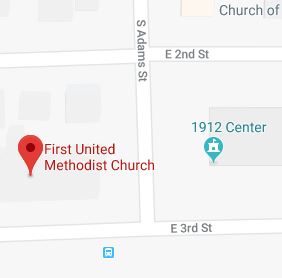
Get Directions
Sunday morning parking at the church is available in the high school parking lot on Third Street across from the church and in the city lots west of the church. These lots are available only on Sunday mornings. A small lot for handicapped parking is available just off of Adams Street on the north side of the church, with an accessible entrance directly into the sanctuary. A lift operates between the Fellowship Hall (3rd Street level) and the Sanctuary. William Sound System Receivers and Headsets are available to assist with hearing problems.
322 East Third Street
Moscow, ID 83843
Church Mission
The First United Methodist Church of Moscow, Idaho takes as our mission to be the body of Jesus Christ, ministering to a community which draws strength from its diversity. Our mission centers on the worship of God, expressed through varied forms of prayer, preaching, music, and ritual. See more...