

Are You Able? - October 18, 2015
The long time pianist at the Omak United Methodist Church used to tell how many years ago a couple, both senior citizens, had become engaged. They planned for their wedding to take place immediately after the Sunday morning worship service. On the day appointed, just before the final hymn, the pastor invited everyone to stay for the wedding. Then he said, "Please turn to #530 in your hymnals and let us sing, "Are Ye Able?"
"Are you able?" Jesus asked James and John when they came to him to ask a special favor: "Teacher, we want you to do for us whatever we ask you." Such an open ended request sounds audacious. "Ask me for whatever you wish, and I will give it," King Herod had promised his step daughter after she had pleased him with her dancing at his birthday party. Herod had promised "Even up to half my kingdom." It was a dangerous offer. Sure enough, after the girl had consulted her mother (who despised John the Baptist) she requested, "Give me the head of John the Baptizer on a platter." Though Herod kind of liked John, having made his offer in front of his birthday guests, he dared not refuse.
"Do for us whatever we ask you," James and John requested. Though we would like to believe they would not have asked for anything as gruesome as did Herod's step daughter, Jesus was certainly smarter than Herod. "What is it you want me to do for you?" he asked them. They answered, "Grant us to sit, one at your
right hand and one at your left, in your glory." That was when Jesus asked them, "Are you able?"
James and John's request was ironic. Just before they asked to sit in the positions of honor, Jesus had taken the twelve disciples aside, and for the third time, predicted that he would soon suffer and die. They had begun to head to Jerusalem and for Jesus Jerusalem meant the cross. This prediction was even more specific than the others. "They will mock him, and spit upon him and flog him and kill him," Jesus had told them.
Jesus says he is going to be killed and the brothers want positions of honor. "Are you able?" Jesus asks. Little did they know that at the cross two bandits would be crucified with him, one on his right and one on his left – hardly positions of honor.
"Are you able to drink the cup that I drink?" Jesus asked. In the bible a cup had a double meaning. "My cup overflows," says Psalm 23. In that case it means blessing and joy, the sign that God provides for us abundantly. A short time after this incident, however, Jesus will share a last meal with his disciples. Holding up a cup he will say to them, "This is my blood poured out for you."
"Are you able to drink that cup that I will drink?" Jesus asks. The Zebedee boys reply, "Lord, we are able."
"Are you able to be baptized with the baptism that I am baptized with?" Jesus asked. Jesus had been baptized in the Jordan River. In this Autumn of baptisms we know the joy of presenting children for baptism when we recognize they belong to God. Perhaps the Zebedee boys remembered that day at the river, when the dove alit on Jesus. They seem not to anticipate the baptism of suffering and death to which Jesus is headed. "Lord, we are able," they assure him.
When the other ten disciples heard about the sons of Zebedee's request they were angry. How dare those Zebedee boys try to weasel their way into Jesus' favor ahead of them! Their anger shows they don't get it any more than James and John do. They too are focused on themselves.
Three times Jesus had told his disciples he would suffer and die. Three times they didn't get it. They had argued over who was the greatest, scratched their heads when Jesus told it was easier for a camel through the eye of a needle than for a rich person to enter the kingdom of God, and now two of them tried to curry favor with Jesus which only angered the others who hadn't thought of it first.
"Whoever wishes to become great among you must be your servant, and whoever wishes to be first among you must be slave of all," Jesus concluded. This too he had said twice before in some form.
I wonder why it was that the disciples, the people closest to Jesus' heart, the ones who spent day and night with him for three years, didn't get it. How could they be so obtuse?
One suggestion is that James and John DID get it, at least partly. Perhaps they had realized Jesus was about to die. In their fear they realized they needed to seek the promise of a secure future now while Jesus was still around. Perhaps they were ready to die with Jesus and were looking ahead to the glory of eternal life so they asked for the positions of honor at the heavenly banquet.
Or it may be that they had indeed missed the whole thing about Jesus' suffering and death and were still intent on their conception of the Messiah as a conquering hero. Maybe they were just plain greedy, trying to grab the best spots for themselves.
Zebedee DNA runs in our veins. We too are caught in what scientists call the fight or flight syndrome. When a threat comes our way we take an aggressive stance in order to protect ourselves and those we love. It grows out of an instinct for survival – fight off the threat before it defeats us, or run from it while you have the chance. Seize the day, as they say. So claim yours while the opportunity is fresh.
The Zebedee DNA also makes us greedy. I know it in myself. I want that basket of raspberries all to myself. If there are cookies in the house, I hope my husband doesn't find them so I can eat more of them. I want more money, more status, more power. I don't think I am alone in that. Years ago I saw an ad for a mini market that promised, "We have everything for all your urgent wants." And there's the truth of it. Most of us are consumed by our urgent wants. It makes us competitive. Like children playing King of the Hill, we want to be on top and if that means shoving someone else down, then so be it.
Discipleship challenges our Zebedee DNA because at heart it is about servanthood. It calls us away from a focus on ourselves to think about the needs of others.
It turns out that transformation takes place through servanthood. Studies show that thriving churches are those which have an outer focus. Rather than spending most of their energy on themselves they engage with their mission field, with their community.
In contrast, declining churches have an inward focus. They concentrate on keeping the building in pristine condition, taking care of their own members, and meeting the budget without annoying people with too much money talk. They look to their own needs first and worry about those outside the church second. Our mission statement says we are committed to living the gospel of Jesus Christ in our community and our world. We risk wear and tear on our building by opening it to community groups and ministries. We support three children and young adults at the orphanage, Jama Letu, in the Democratic Republic of the Congo. We host Family Promise. Several of our members are key players with Habitat for Humanity. We live the Gospel of Jesus Christ in our community and our world.
Whether it is as individuals or as an organization, the true measure of our priorities shows up in the use of our time and our money. For individuals that shows up on our calendars and our check books. For a church I would say it shows in our calendar and our budget.
Are you able? Jesus asks us. Mission for our church is not a budgeted item. While the building gets a line item, the Mission Committee has to raise funds through bake sales and special appeals. I would suggest to you that an outer focus, a servant ministry, would incorporate itself into a basic commitment not something extra. I'd like to see us begin to budget for missions.
Jesus said, "Whoever wishes to be great among you must be your servant, and whoever wishes to be first must be slave of all."
Are we able to look outside of ourselves? Are we able?
Current Church News
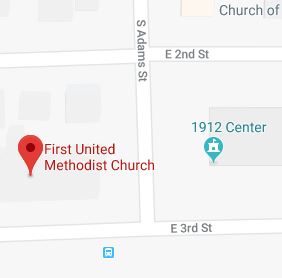
Get Directions
Sunday morning parking at the church is available in the high school parking lot on Third Street across from the church and in the city lots west of the church. These lots are available only on Sunday mornings. A small lot for handicapped parking is available just off of Adams Street on the north side of the church, with an accessible entrance directly into the sanctuary. A lift operates between the Fellowship Hall (3rd Street level) and the Sanctuary. William Sound System Receivers and Headsets are available to assist with hearing problems.
322 East Third Street
Moscow, ID 83843
Church Mission
The First United Methodist Church of Moscow, Idaho takes as our mission to be the body of Jesus Christ, ministering to a community which draws strength from its diversity. Our mission centers on the worship of God, expressed through varied forms of prayer, preaching, music, and ritual. See more...