

Two Cent’s Worth - November 8, 2015
Ruth 3:1-5; 4:13-17
Mark 12:38-44
A few cents, that's all she had. Just a couple of pennies that were worth almost nothing. When she tossed them into the temple treasury they made almost no sound at all. On an average day no one would have noticed the old woman dropping her little coins into the metal trumpets that served as the donation chests. Not like the rich people whose larger offerings rattled and clanked with satisfying noise so that everyone knew just how generous they were. No, the old lady's offering would have attracted no notice.
A few cents, and yet Jesus noticed. He contrasted her offering with those of the wealthy. "Truly, I tell you, this poor widow has put in more than all those who are contributing to the treasury. For all of them have contributed out of their abundance; but she, out of her poverty, has put in everything she had, all she had to live on."
Give of your living not of your leftovers. I've preached that more than once, often based on this text. It is a good theme for stewardship drives. It is an appropriate message to those of us who are wealthy in contrast to so much of the world. The widow's mite is a model to us of faithful living and giving.
There may be another way to see her, however. In the previous paragraph Jesus had condemned scribes "who devour widow's houses." Scribes, as their name implies, were people who were in charge of legal documents, especially financial ones. They could read and write, a rare skill in a day and age when many people were illiterate. Now, most likely, many scribes took their duties seriously and did their best to execute them faithfully. Just before today's reading, Jesus and a scribe had discussed which commandment was the greatest, and Jesus had noted that the scribe answered wisely.
Like any profession, the few people who abuse their privilege give the rest a bad name. Some scribes, apparently, went in for all the power and prestige they could get. At least a few took advantage of the most vulnerable in their society – they devoured widow's houses.
Over thirty years ago, when I served two tiny churches while I was in seminary, someone told me that the local funeral director owned a lot of real estate in the area. The rumor was that if a widow could not pay her husband's funeral expenses the funeral director would buy her house, deducting the cost of the funeral. I don't know how true that rumor was, and I've never heard it since about any other funeral home. And I always think of it when I read this passage.
Connect the charge against scribes who devour widow's houses with the widow who gave to the temple all that she had to live on, and Jesus' words may be an indictment against a system which manipulated her to give of her living. A few cents might have been her only meal for that day. A few cents might have been the only thing between her and a night spent huddled on the streets. Contrasted with those who gave much and sacrificed little, Jesus' words may have not so much held her up as a model as condemned a system which took from her what she could not afford to give.
The Protestant Reformation began in large part over the fiscal abuse of the poor who were told by the church that they had to buy indulgences in order to be forgiven for their sins. And if they wanted to get their loved ones out of purgatory – a sort of temporary hell – they could buy indulgences for them. Indulgences were a fancy term for money given to the church, often for major building campaigns, like the one which built St. Peter's Basilica in Rome. Martin Luther recognized how wrong this financial manipulation was. It took the widow's mite and devoured her house.
We don't sell indulgences anymore and that's a good thing. We do run stewardship drives in which we ask people to estimate how much money they will give to the church over the next year. It is very helpful to the finance committee to have a sense about how much money we have to operate the church. We encourage people to increase their giving each year. The Biblical model is to give ten percent. I don't see the pledges and I don't know what any one gives. I don't know people's incomes either, so I can't say how close to ten percent anyone is. I do know that the national statistics suggest that most people give more like two or three percent. Assuming that is close to the situation here, if we could average even five percent our financial worries would be over.
And I have to ask myself how often our stewardship drives border on oppression of the most vulnerable among us? Do we manipulate elderly people, living off a small social security check, to give of their living to the extent that they are left destitute? Do we shame people for giving only of their leftovers? I hope not – and I'm afraid I've been a part of doing so over the years.
Ruth was also a widow. She too is a model for us of faithfulness and loyalty. When her husband died, the typical thing for a woman in her day and age to do would have been to go back to her family of origin. Instead Ruth stuck with her mother-in-law, Naomi, who was also a widow. Ruth was from Moab, which was where she married Naomi's son. When all the men died Naomi decided she would go back to her family in Israel and Ruth went with her.
Society provided for these two widows in a couple of ways. The Hebrew law told farmers to leave the edges of their fields unharvested so the poor could glean food for themselves. Ruth did the hard work of gleaning and was able to bring food home to Naomi – food she could get because the law made it possible.
Naomi also knew that the law provided for a kinsman-redeemer. This was the closest male relative who was obliged to marry a widow and raise children in the dead husband's name. It sounds awkward to us – and it was a way that society ensured that women would be cared for in the event of a tragedy. So Boaz married Ruth.
At its best the church today liberates people rather than oppressing them. At our best we proclaim a God who loves and welcomes us, not a God who condemns and rejects. We worship a God who loves us as we are, warts and all. It doesn't matter what you look like, how much money you make, or quite honestly, how much you give to the church. God loves you. It doesn't matter how much education you have, what your sexual orientation is, or how many church committees you have served on. God loves you. It doesn't matter how many Bible verses you can quote or if you don't have a clue how to even find the book of Ruth in the Bible. God loves you. I hope you hear that here, today and every day.
At its best the Church liberates people. Last month the Ronald United Methodist Church in the Shoreline area of Seattle, broke ground on the Ronald Commons, an affordable housing project designed by an alliance with two other agencies. In an area with lots of homelessness it is a partnership which offers permanent, low income housing, paired with services aimed at moving people out of poverty. The land for this sixty unit facility is adjacent to and owned by the Ronald UMC. To people who have long felt unwelcomed by the church, or even manipulated and oppressed by the church, it offers hope and liberation. The Ronald UMC is advocating for and welcoming people who are among the most vulnerable in our society. They are proclaiming, in the most practical ways, a God of love. Rather than devouring housing they are providing it. The fruits of their worship are extended in all who believe.
Martin Luther taught that the ministry of Christ is carried out by the priesthood of all believers. We live the Gospel of Christ when each person conveys the love of God at work or school, on the soccer field and in the football stadium, at home and in the community.
As we conduct our stewardship campaign, I ask you to give generously, and please make sure you can care for your own needs and those of your family. The Nominating Committee is just concluding our work in recruiting officers and committee members for various positions. They are conducting a campaign for the stewardship of our time. Thanks to those who give of your time and talent to our church. And again, make time with your family a priority. Allow space to take care of yourself. The Gospel is to liberate and not oppress. Jesus gave of his living that we might know peace and joy. He put in his two cents worth that we might live.
Current Church News
Get Directions
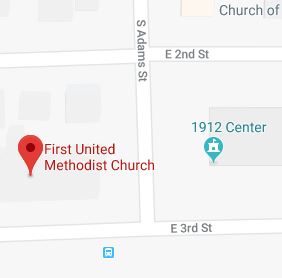
Sunday morning parking at the church is available in the high school parking lot on Third Street across from the church and in the city lots west of the church. These lots are available only on Sunday mornings. A small lot for handicapped parking is available just off of Adams Street on the north side of the church, with an accessible entrance directly into the sanctuary. A lift operates between the Fellowship Hall (3rd Street level) and the Sanctuary. William Sound System Receivers and Headsets are available to assist with hearing problems.
322 East Third Street
Moscow, ID 83843
Church Mission
The First United Methodist Church of Moscow, Idaho takes as our mission to be the body of Jesus Christ, ministering to a community which draws strength from its diversity. Our mission centers on the worship of God, expressed through varied forms of prayer, preaching, music, and ritual. See more...