

The Wells of Salvation - December 13, 2015
It is not uncommon for people to wander in off the street, curious about our magnificent building. Last spring as I showed one such couple up to the sanctuary, I asked them where they were from. "We're refugees from California," the woman said. She went on to explain that they were both retired. Normally they grow a large vegetable garden. Tending the garden and preserving its bounty normally keep them close to home all summer. This year, however, the severe drought in California had dried up the well which they use to water a garden and so they did not plant one. They decided to travel north and happened to come through Moscow. It was early enough in the spring that things here were still green and they marveled at how lush things looked.
Of course, by this fall the Palouse was even browner than usual. When I worked in my own garden I realized how dry it was. Lack of snow in the mountains last winter also led to terrible fires this summer. While the Palouse was spared fires, we did get smoke. Some farmers reported adequate yields on their crops but others found that their yields were disappointing at best. We too know drought.
I think of the Holy Land as an arid place. It is true that some parts are very dry. When I googled rain fall in Palestine I learned that indeed in some parts there is little rain, especially from early spring to late autumn. Particularly near the Dead Sea the terrain is dry. Other parts, however, like the region of Galilee, are more temperate – the web site noted "like California." It didn't qualify whether that was under normal conditions or in this last year.
When the Hebrew people escaped slavery in Egypt they thirsted in the wilderness. Wilderness in the Holy Land is often the desert. And so the people cried out for water, sure they would die of thirst. The image of thirst continues to come up in the Bible, both as a reflection of the world they lived in and as a metaphor for the state of their souls. As the prophet Isaiah anticipated the time when Judah would be defeated by the Babylonians, he wrote, "Therefore my people go into exile without knowledge; their nobles are dying of hunger, and their multitude is parched with thirst." After the exile had taken place, another Isaiah wrote "All people are grass . . . the grass withers, the flower fades." For that Isaiah drought was not so much a matter of rainfall as of their relationship with God. In the same way, many years later when Jesus spoke of living water to the woman at the well she asked, "Sir give me that water so that I may never be thirsty." She wondered where Jesus' bucket was and it took her a while to figure out Jesus was talking not of H2O but of the spirit.
Throughout the Bible as people moved into a region they dug wells – a sign of settling into an area and claiming it as their own. Wells were a sign of God's provision and care.
My cousin Dawn and her husband Larry live in a suburb of Los Angeles. Like everyone else this summer they were under water restrictions. Larry has worked hard over the years on his yard and he did not want to let it turn brown, but the limits on water use meant irrigating grass was not an option. Larry, however, discovered a small spring in their yard that continued to flow even in the drought. He found a way to tap into the spring to keep his yard green. I haven't heard how his neighbors felt about that, but Larry was happy.
As we lit our third Advent candle this morning we sang the song of Isaiah and read the surrounding verses. Some people might call this Isaiah's drinking song for he says, "With joy you will draw water from the wells of salvation." The word for well can also mean a spring. Isaiah's song may have been associated with a festival that included drawing water and celebrated wells for the life giving water they provided. They were, for the people of Israel, a sign of God's salvation.
"Surely it is God who saves me, I will trust in him and not be afraid." The water they drew from the wells not only signified to them physical survival it also spoke of their spiritual well being.
Salvation in Hebrew is yeshow'ah, the root of Jesus' Hebrew name, Joshua. It means welfare or prosperity. In Greek the word for salvation is sozo, and means wholeness or health.
As Christians we trust in God to forgive us for our sins. Surely there is nothing we can do which can permanently separate us from God, for God has become one of us. We need not fear God. Yes, we sin. Sometimes we sin in big ways, sins that our government calls crimes, sins that break the "you shall not's" of the Ten Commandments, like theft and murder. And more often we sin in quieter ways. These sins won't get us arrested. Often no one else will even notice, yet sins like envy and greed, hatred and anger, lust and pride, are sins nonetheless.
God saves us from our sin by forgiving us, by washing us clean of the wrongs we have done. Like water cascading over us in the shower to cleanse our bodies, so God's love bubbles up within us to wash away our sin.
Having been forgiven by God, we are enabled to forgive others. Indeed my most common prayer of confession is to admit my resentment of others and to plead for God's grace to help me forgive them. In forgiving we are then freed to live more joyfully.
"With joy you will draw water from the wells of salvation." (Pour)
Ethan was an irrepressible three year old in the church I served in Omak. When I called for the children to come forward for the Children's Moment, his parents would sink down in the pews, unsure just what he would say. The rest of the congregation, of course, delighted in him. For months as I dismissed them at the end of the Children's Moment, saying, "If you are three or younger you may go to the nursery," Ethan would pipe up, "Or on Salmon Creek," because his family lived on Salmon Creek. When his parents asked me to baptize Ethan and his brother Malcolm, I got water from Salmon Creek to use in the baptism.
The sacrament of baptism remembers the many ways in which water figures in the history of salvation, including that Jesus was nurtured in the water of a womb. There are multiple meanings to baptism, including that God washes us clean of our sin. The core meaning, however, is that in baptism God claims us as beloved children. We are marked forever as belonging to God.
"With joy you will draw water from the wells of salvation." (Pour)
I hear that California has gotten rain this fall, and the El Nino forecast predicts they are to have a wetter than usual winter. Whether it will be enough to break the drought remains to be seen. I think sometimes of those refugees from California and hope they'll be able to plant a garden again next spring. Water nourishes growth. I've lived on the edges of both the rainforest and the desert. I know the value of water. I'm grateful that we too have gotten rain this fall and I hope the mountains get a solid snow pack this winter.
God's salvation nourishes life among us. The Hebrew people crossed the Red Sea as they fled slavery and entered a land of plenty, surely a well watered land. Jesus was baptized in the Jordan River by his cousin John and a voice from heaven proclaimed, "You are my beloved son with whom I am well pleased." The Holy Spirit comes to us today, empowering us to live out God's grace. We sing God's praises; we shout aloud and sing for joy, for great in our midst is the Holy One of Israel.
"With joy you will draw water from the wells of salvation." (pour)
In a few weeks we will celebrate the festival of the incarnation when God took on human flesh and was born as the Bethlehem Babe. In Jesus God truly came into our midst.
"With joy you will draw water from the wells of salvation." (pour) The drought in our souls is over and our joy overflows. Surely it is God who saves us.
Current Church News
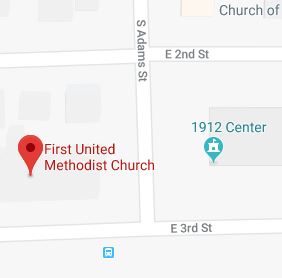
Get Directions
Sunday morning parking at the church is available in the high school parking lot on Third Street across from the church and in the city lots west of the church. These lots are available only on Sunday mornings. A small lot for handicapped parking is available just off of Adams Street on the north side of the church, with an accessible entrance directly into the sanctuary. A lift operates between the Fellowship Hall (3rd Street level) and the Sanctuary. William Sound System Receivers and Headsets are available to assist with hearing problems.
322 East Third Street
Moscow, ID 83843
Church Mission
The First United Methodist Church of Moscow, Idaho takes as our mission to be the body of Jesus Christ, ministering to a community which draws strength from its diversity. Our mission centers on the worship of God, expressed through varied forms of prayer, preaching, music, and ritual. See more...